

A senior executive recently approached me, visibly under high pressure from his top management. "We need to change our strategy!" he declared, citing an unexpected move from a competitor. In a world where, according to McKinsey, executives spend nearly 40% of their time on decision-making, yet 61% report that at least half this time is used ineffectively, my first response was a call for pause:
Strategic agility begins with critical thinking, not immediate change.
So, we decided to analyse the situation first. To ensure an unbiased approach, we used the 4 Points of Tension situational intelligence model, a framework designed to bring clarity to complex scenarios by examining the interplay between Stakes, Risks, Openings, and Stakeholders.
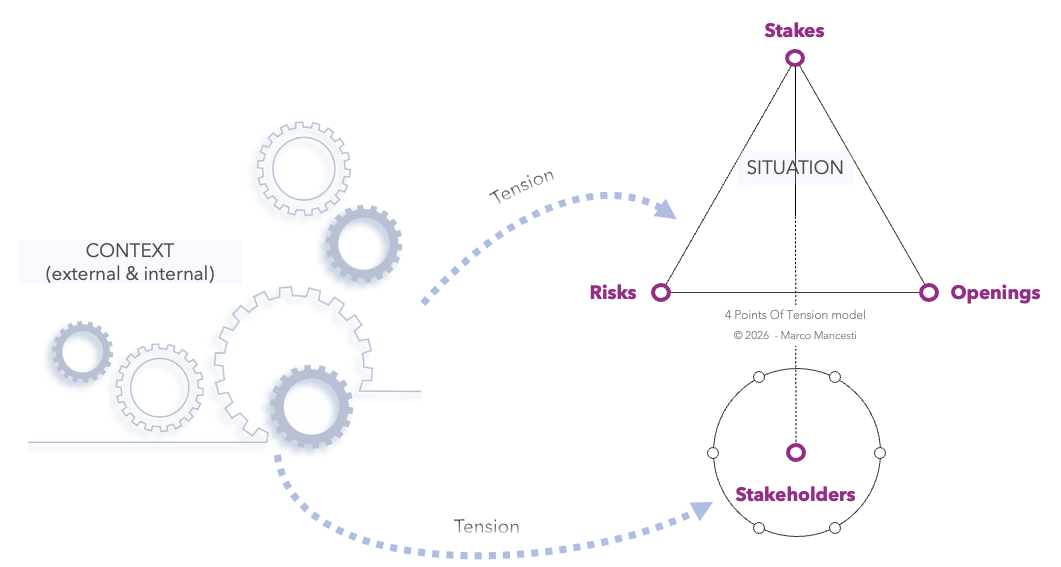
With a clearer picture, we quickly determined that doing nothing was not an option. It would lead the organisation toward a critical threshold, what adaptation planning literature terms a "tipping point", where the mission could no longer be executed.
Changing yes, but what? To find out, we inverted the typical strategy process, working our way up from the tactical to the foundational:
- ➡ Is the execution plan impacted?
- ➡ Are the main strategic streams in question?
- ➡ Is the entire strategy or business model obsolete?
- ➡ Are performance indicators to be revised?
- ➡ How about the defined values and operating principles?
- ➡ Is the vision impacted?
- ➡ And the mission itself?
By working up the strategic hierarchy, we discovered the disruption was contained at the level of strategic streams. The core strategy and business model remained sound. The necessary adjustment was tactical: the plan had to be modified, and a flagship product launch needed to be reframed and delayed.
Interestingly, the competitor's move actually created an opening to fast-track an AI functionality originally planned for later, thereby creating a superior value proposition. The rest of the strategic architecture was not under threat, at least for the moment.
Sometimes, the disruption is not that contained. I encountered a case where a substantial cut in public subventions forced a complete reshaping of a company’s vision, a disruption that ultimately sparked a breakthrough.
In another organisation, the diagnostic was much trickier because on the surface, all strategy execution projects were reported as being on track.
In an article back in 2012, that was featured by the Financial Times, I talked about the risk of getting lost in the details. In this organisation, that was exactly the point, we would not find an issue in the execution plan, but in the balance between execution and measurement.
The picture basically looked as follows:
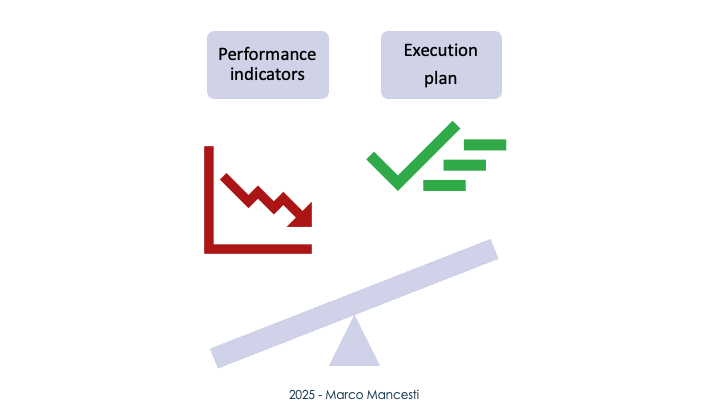
The CFO’s top-line projections were not matching their ambitions, despite reports that strategy execution was proceeding according to plan. This signalled a critical disconnect. In such cases, either the ambitions are unrealistic, the strategy is flawed, or something else is at play.
Digging deeper with the head of strategy, we found the problem was not in the plan but in something more profound. The reporting was flawed by a mushrooming of committees, each incentivised to report positive results to avoid scrutiny from top management. This created a consolidated, but false, picture of health. The internal situation was far less rosy. We discovered numerous undeclared initiatives, what I call "submarine projects", consuming resources without formal reporting or strategic alignment. Furthermore, many exploration initiatives were being managed as execution projects, lacking the rigorous evaluation criteria needed to terminate them promptly when they failed to deliver expectations.
The issue was a toxic mix of governance, leadership, and culture. From a governance standpoint, we dismantled most committees and performed an in-depth review of the project portfolio. We then took the lead to stop a number of projects, reframe others, and reallocate resources. Finally, we tackled the most crucial element in any high-performing organisation: accountability. This had nothing to do with the strategic plan itself, it was about culture.
When we focus on external alertness, we only look at one side of the coin.
The often cited phrase "Culture eats strategy for breakfast", widely but incorrectly attributed to Peter Drucker and more likely linked to Ford's Mark Fields in 2006, captures a critical truth validated by decades of research. As Edgar Schein’s three-layer cultural model demonstrates, deeply embedded assumptions and values can overwhelm even the most sophisticated strategic plans.
The duality of internal and external context is a core principle in strategic management, which mandates a thorough understanding of all issues that can impact strategic objectives. While external alertness (scanning for market disruptions and competitive moves) is vital, internal context monitoring remains equally critical and is often forgotten.
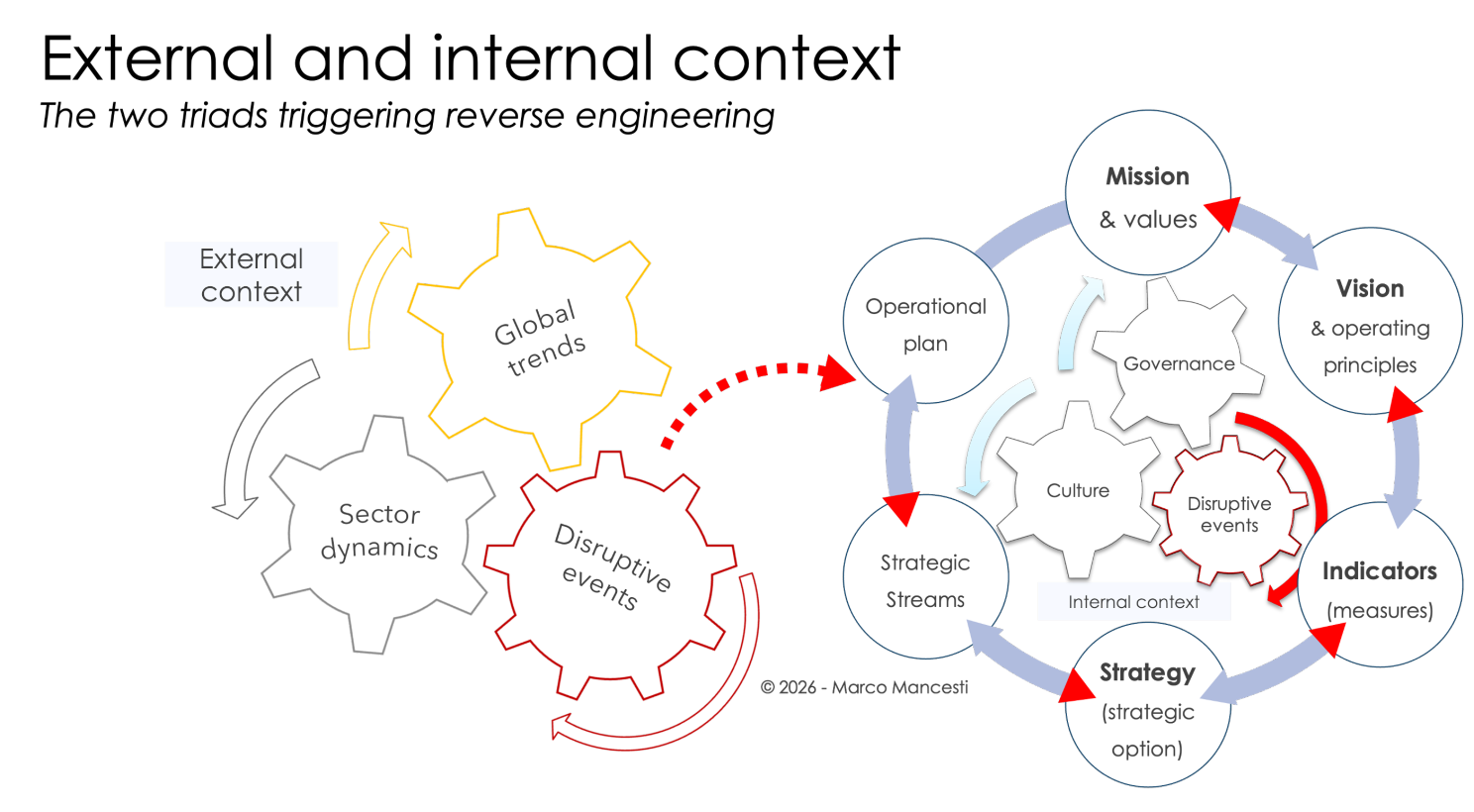
In other words, there are two, not one, triads of foundational enablers/inhibitors to strategy execution. The external context has its own dynamics, but the internal context is where execution truly lives or dies. It has its dynamics as well, including disruptions (think NGOs when a member of their team gets taken hostage abroad. :
- Culture: The shared assumptions, values, and behaviours that dictate "how things are really done around here".
- Governance: The formal structures and processes that ensure clarity of responsibility, quality decision-making, and rigorous accountability.
When these internal enablers are weak or misaligned, for example in case of poor leadership, even the most brilliant strategy will fail.
In my earlier post The Disruption-Fit Maturity Scale, I introduced eight “integrities” that determine whether a company is merely surviving disruption or is actually fit for it, meaning that it will exploit global changes affecting its environment to get stronger and create shared value. One of the most evident is the one we just explored, the action integrity. It keeps an organisation moving in a coherent and agile way while the storm is generating chaos all around. Even more, organisations that have reached the disruption-fit level use these adaptations to thrive.
Originally posted on LinkedIn