


In my earlier post The Disruption-Fit Maturity Scale©, I introduced eight “integrities” that together determine whether a company is merely surviving disruption or actually disruption‑fit. The first of these is the Integrity of Intention. On its own it does not make an organisation disruption-fit, but it plays a foundational role within the broader whole. Its wholeness keeps an organisation anchored while it flexes and adapts in turbulent times.
This article is not meant to be a novelty; it digs into the well-known principles from Drucker, Porter as well as Kaplan & Norton. However, it reminds us of the crucial need to take the fundamentals seriously. At a time when every news cycle brings fresh disruptions, that rigour may well mean salvation.
I often use the image of a compass. During magnetic storms or solar flares, the needle loses its ability to point North. That's exactly what happens in poly-crisis moments: the strategic needle goes frantic. Yet in many firms the problem is not the agitation of the needle, it is the absence of cardinal points altogether. Without a clear intention, teams drift, decisions clash, and disruption becomes a threat rather than a source of value‑creating openings.
Clear intention goes far beyond a brochure of noble statements and posters on the institution’s walls.
Mission and values exist in most organisations, but if they are not brought to life repeatedly throughout the year, they might as well not exist, because what people do not hear, see and practise regularly slowly disappears.
The Four Cardinal Points
- North is the MISSION: Why does the institution exist? What does it do? For whom? What are its boundaries? Where does it operate?
- South holds the VALUES: What do we believe in? How do we treat each other and our stakeholders while delivering our mission? What is our DNA?
- East points to VISION: What do we aspire to become? How do we inspire decisions and actions?
- West contains INDICATORS: How does success look in concrete, measurable terms along the journey to vision?
These four points form an equilibrium, a frame. Mission tells us why we exist; values tell us how we behave; vision shows us where we aim to go; indicators translate that ambition into tangible outcomes we can measure all along the journey.
Let’s look at mission in more detail as it is so foundational. A good mission statement is a paragraph that describes an organisation's "raison d'être", clarifying the type of services or products provided (what), the target audience or beneficiaries (for whom), and the way these objectives are achieved (how). It also clarifies what we do not do, which beneficiaries we do not serve (for example geographical limits), and the means we intend to use.
If you can’t explain it simply, you don’t understand it well enough.
The sentence is well known, and probably wrongly attributed to Albert Einstein. It does not really matter. Research consistently shows that strategic clarity and shared vision distinguish high-performing organisations, with mission and vision serving as the foundation for aligned decision-making across organisational levels.
The most inspiring vision never realises without metrics. The most guiding mission does not stand without shared values.
Strategy: aligning map and compass
Strategy is what gets an organisation from its current point to its vision. Strategy is the map. To know where you are and which way to go, you need to align the map and the compass.
In extremely turbulent contexts, when disruption hits, the needle spins. The link between the vision and the strategy or execution plan is temporarily broken. This is bad and good news at the same time. In principle, only the navigation toward your vision is disturbed, but if you have defined and communicated a clear mission, values and indicators, you can still operate. People know why they are here, how they should behave and what success looks like, even if the route needs to be redrawn.
If this work has not been done, this is where organisations go frantic. When no shared cardinal points exist, the loudest voices or the latest emergency end up defining direction.
The intentions' reverse‑engineering
When the needle is spinning, this is the right moment to ask strategic questions. Is the turmoil temporary, or is it a game-changing disruption? If it is the latter, it becomes necessary to engage in what I call intentions' reverse-engineering.
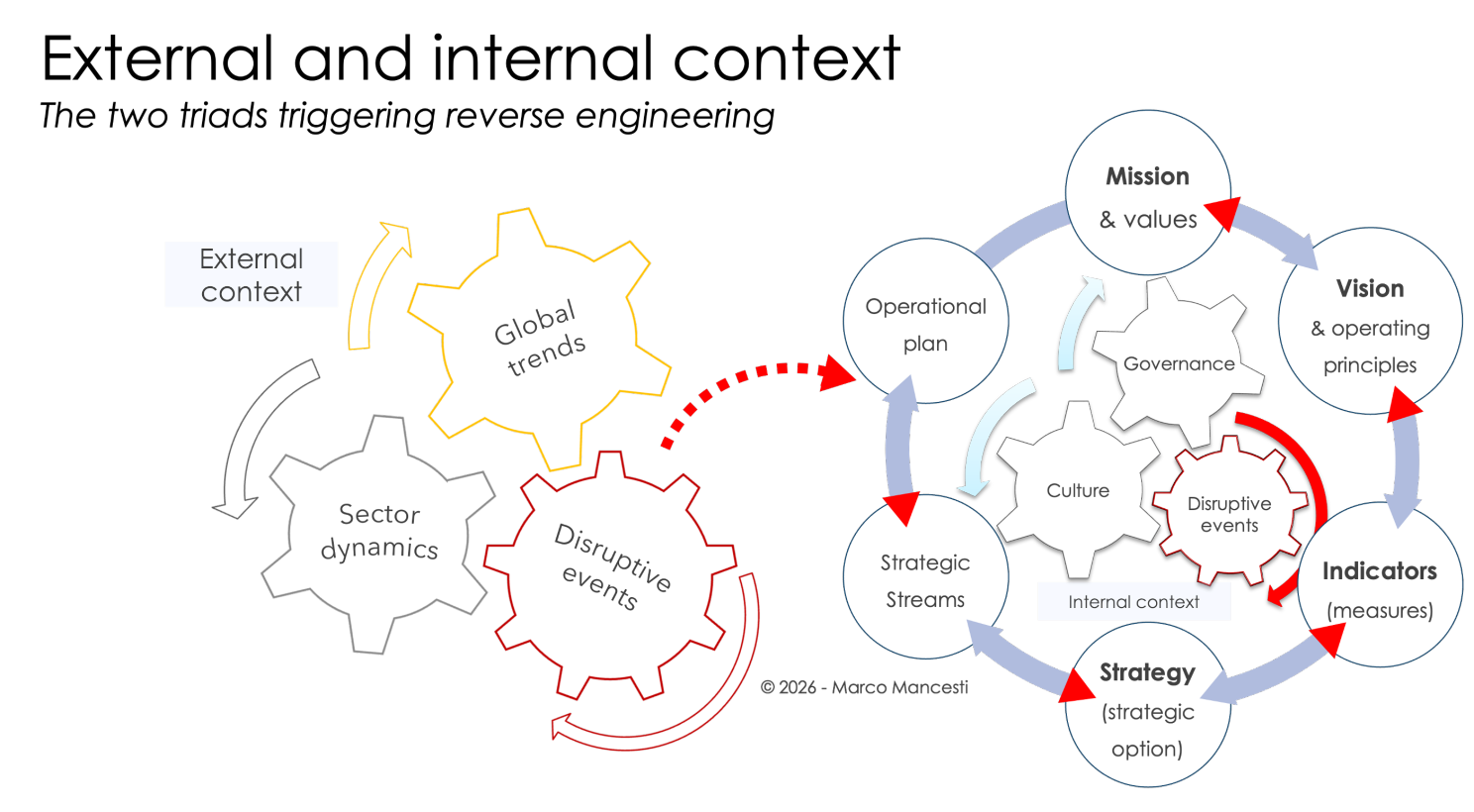
Practically, this means revisiting the chain from execution back to the main intent. Do our current execution plans still make sense in this context? What about our strategic streams? And our strategy itself? If these remain valid, the examination moves upstream. In some cases, the shock is strong enough that indicators need adjustment, or even that elements of the vision or mission must be reframed.
The accompanying diagram illustrates this reverse-engineering flow from both external disruption and internal disruptive events through the sequence of intentions.
A senior executive once told me: “It was during that hectic period that we had the best conversations about the company.”
From disruption-adverse to disruption-fit
In a disruption-adverse organisation, the lowest level of the The Disruption-Fit Maturity Scale©, mission, values, vision, and indicators are vague or missing. Walk the corridors and you hear: "We don't know where we're going." Sit in planning meetings and you witness: "Management flipped direction again."
In a disruption-fit organisation, the highest level of the The Disruption-Fit Maturity Scale©, the four cardinal points are alive, visible, reinforced continuously. Town hall meetings open with them. One-to-one reviews connect to them. Performance evaluations measure against them. Values are sacred cows, and when they are repeatedly violated at senior levels, governance mechanisms are expected to respond to protect the organisation’s culture.
In such organisations, storms, even magnetic ones, can become opportunities to create value rather than sources of disorientation.
Beyond the C‑suite
Many leaders assume the compass framework applies only at the top. This is a mistake. Every department and business unit must be clear about its specific contribution to the overall purpose, vision, and indicators.
In practice, this means each entity should have its own, fully aligned, cardinal points. Commercial teams, operations centres, finance departments all need to understand their mission, vision, and indicators within the broader organisational frame. Values are the exception. While units may develop function-specific operating principles, the organisation as a whole must share a coherent and consistent set of values.
A robust Integrity of Intention does not prevent the strategic needle from spinning, but it prevents the institution from losing itself when it does.
In disruption‑fit organisations, the compass does not eliminate the storm. It simply ensures that, once the needle settles again, everyone still knows who they are, what they stand for and what they are ultimately trying to achieve.
Originally posted on LinkedIn