


"Money time!" The expression was popularized in France by George Eddy, a French-American commentator, during his broadcasts of US National Basketball Association (NBA) games on French television. "Money time" designates, in sports language, the decisive period of a game, usually the last minutes or the last quarter. This is the moment when the pressure is at its maximum, when every action can change the result. That's when star players are expected to make the difference. In this sense, "money" could refer to their salaries in relation to the earnings they bring. Does this sound familiar? Making the difference in difficult times is also how top CEOs are supposed to justify their salaries, or top politicians to honor their mandate.
The critical reality of Executive Decision-Making
McKinsey research shows that executives on average spend almost 40 percent of their time making decisions and believe most of that time is poorly used. Even more concerning, only 20 percent of respondents say their organisations excel at decision making.
In my earlier post The Disruption-Fit Maturity Scale, I introduced eight “integrities” that determine whether a company is merely surviving disruption or is actually fit for it, meaning that it will exploit global changes affecting its environment to get stronger and create shared value. One of the most overarching, and arguably the most critical, is the decisional integrity. It's the one that keeps an organisation above water while the storm is creating chaos all around.
For leaders, decision-making is surely the top skill, that requires everything to get together, from situational intelligence and strategy skills, through foresight, humility, courage and last but not least, groundedness.
"Make the difference". The Paradox of Speed and Quality
In the instance of NBA games, the stars have a fraction of a second to make a decision. Do they shoot, do they go for the basket, do they move out of the two-point line for a 3 pointer? Some tactics here, but mostly intuition. Pure talent? Talent is nothing without commitment, dedication, consistency and focus, all top athletes will confirm. There is also almost consensus in research to confirm that intuition without competence and experience is close to gambling when it comes to decision-making.
When the decision needs to be made in the blink of an eye (by the way, "Blink" is an excellent book on decision-making), then it's all about intuition. Break or go, we've made that call so many times while driving, don't we?
So for leaders it's all about intuition? After all, the journey has often been very long before getting to the top, they do have the training! Moreover, they are indeed expected to decide fast, and lead means decide! Well...
First, to lead doesn't always mean decide. To lead means making sure that the decision is made timely, qualitatively and at the right level in the organisation.
The latter is extremely important. Not only seeing a leader decide on everything may pose some questions on adequacy with today's expected leadership style, this approach is counter-productive in a time of constant volatility and polycrisis.
McKinsey Research again strongly supports this view: "when decisions are made at the right level—which, in many cases, means delegating decisions down to lower levels of the organisation, leaders are 6.8 times more likely to be part of a winning company".
Second, the how is equally instrumental. The research on decision science is definitely very rich of complex models, implying that good decision-making requires sophistication. Yet McKinsey research challenges the traditional assumption that speed compromises quality: “faster decisions tend to be higher quality, suggesting that speed does not undercut the merit of a given decision. Rather, good decision-making practices tend to yield decisions that are both high quality and fast”.
Jeff Bezos integrates this notion, mainly for the "reversible decisions", with his "70% certainty threshold principle" explicitly formulated in his 2016 Amazon shareholder letter. This rule states that most decisions should be made when you have approximately 70% of the information you wish you had, rather than waiting for 90% or 100% certainty, in order to avoid decision paralysis.
Redefining Leadership Decision-Making
Fast does not mean precipitate, and does not mean absence of process. It means frameworks that are adapted to the situation and practicable. So the very start is knowing which model applies to which circumstance. From that standpoint, the Bezos decision matrix, that combines reversibility of a decision with its impact, is brilliant to provide advice on the depth of thinking required before making a decision. Basically, reversible equals less thinking, whilst irreversible means more attention and depth.
Nevertheless, the Bezos Decision Matrix is lacking a perspective: the time constraint. In the proposed extension of the Bezos matrix below, I am excluding "blink" situations to compare the cases when there is either limited time (say a couple of minutes) to make the decision, and when there is, although not infinite, comfortable time to decide.
Bezos' extended Decision Matrix
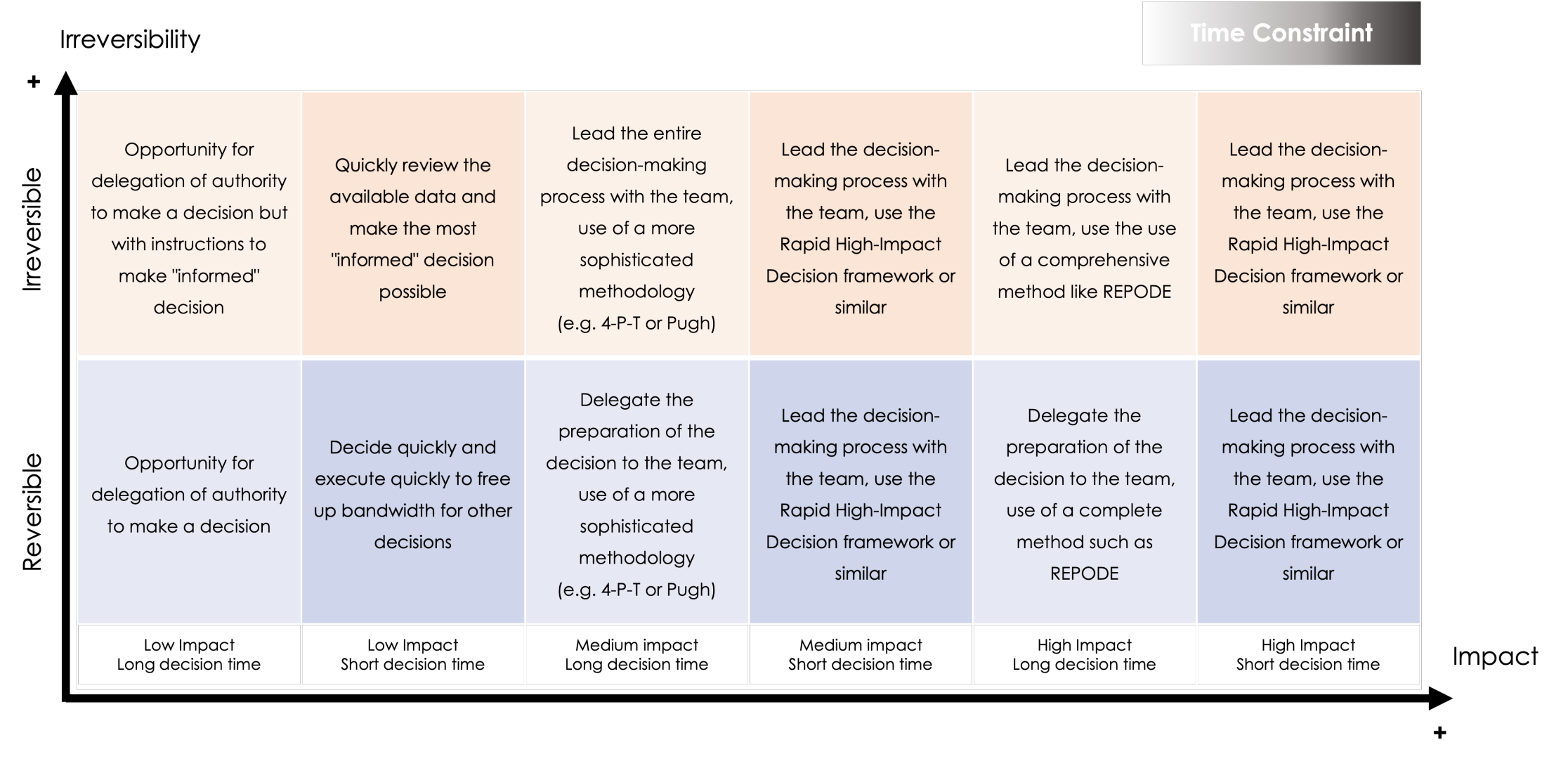
Also worth noting that to some extent, the extended Bezos Decision Matrix could remind us of the Eisenhower Matrix, with its importance versus urgency approach. However, the Eisenhower matrix is much more oriented towards task management than decision-making.
So, when studying the above enhanced matrix, what we first observe is, there are instances where you can delegate the authority to make the decision, and instances where you can't. It is important because delegation is one of the most powerful catalysts of organisations that are fit to disruption. But this is the subject of another article.
We also see that short time means limited bandwidth for analysis. So that limited time needs to be well used. Typically, in a couple of minutes our brain will not be able to process a full criteria-based analysis as per Stuart Pugh matrix or AHP of Thomas L. Saaty.
So, in a situation where there are just a couple of minutes to make a decision, where impact is high and there is no reversibility, the proposal is to use a framework that focuses on just two critical elements: framing and enabling.
5 steps Rapid High-Impact Decision Framework
Framing is obviously preceded by a thorough analysis of what is happening, making the difference between facts, information, interpretation and opinions to get full clarity. Then we can ask the key question: what is at stake? This question is critical because it forces us to take distance from jumping into the immediate outcome (enabling), to put our ego on the side and frame what the problem really is. "What is at stake" means asking the two following questions:
- What is it that we have, that we possess today (and in most cases it is immaterial), that could be lost with the wrong decision or course of action?
- Who are the people that will be most impacted by the decision? What is the impact, and how will they react?
Think about it: How many arguments between friends, within couples, within families could have been avoided if, before speaking, we would try to understand what is at stake?
Second point, when we ask "who are the people that will be most impacted by the decision", then we also get to know which stakeholders need to be taken care of. McKinsey's findings show that getting commitment from relevant stakeholders makes organisations 6.8 times more likely to be decision-making winners.
Now that you've framed the problem correctly, you are ready for "enabling" the solution and the action with the following questions:
3. Are there any constraints? Which are absolute, which are relative ?
4. What are the options?
5. What are the most urgent actions to be executed in order to "buy time" ?
It doesn't take a lot of time to ask these five questions, nor a lot of brain bandwidth. Yet it changes the perspectives for two reasons. First because you have the main elements of your problem in your head, and second because going through these steps forces you to get back in control of your emotional state.
Contextual Intelligence and Decision Quality
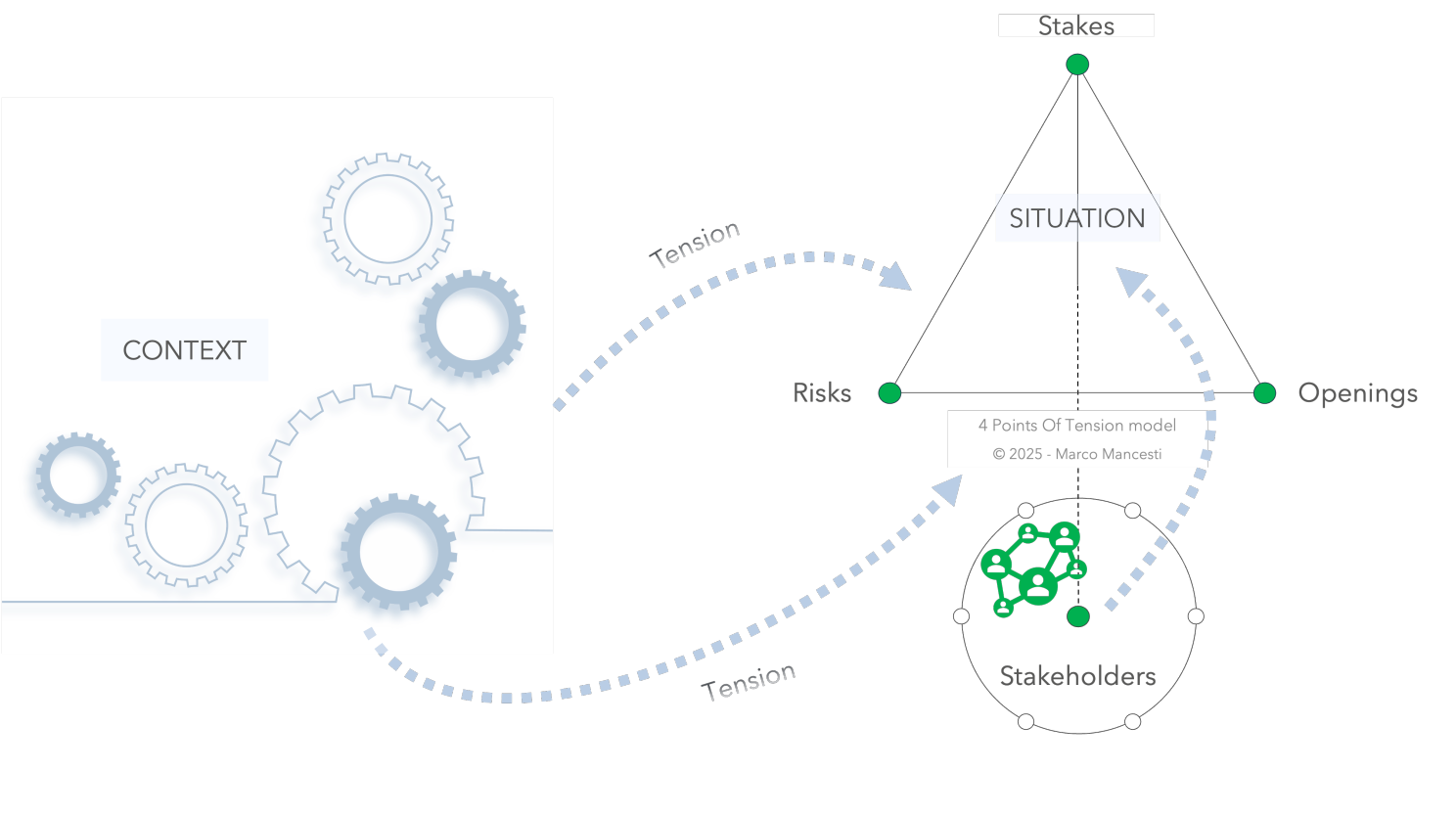
When there is more time available, and impact is medium then we can introduce an additional element to the framework, which is context and its understanding, in other words, situational intelligence. But let's first define what I mean by "context": it is the sum of all external trends, often defined through the acronym PESTEL (or STEEP), referring to the political, economic, social, technological, environmental and legal trends going on at a given point in time. These could be confirmed trends or weak signals. To these global trends we need to add the dynamics that impact the ecosystem (industry, business, public or NGO sector) and the dynamics internal to your institution. All these factors move continuously and impact you.
The 4 Points Of Tension situational intelligence model
So changes in the context trigger decision-making because they put in tension 4 aspects that define your specific situation. In the visual below, I explain how to get full understanding of the impact of context alterations: What is at stake? What are the risks ? What are the openings ? Who are the stakeholders and how they are positioning themselves ?
Why is this important?
Whilst a "blink" decision may turn right or wrong, it can't turn obsolete. On the contrary, most business decisions become obsolete at some point, because context is changing. In other words, the very contextual reason why you've decided one way or another, is the same that can turn your decision totally wrong down the road.
Now we get to the hot quadrant where a decision is irreversible and high impact, but there is time available. The decision becomes strategic, it is the kind of turning point or tipping point decision.
For leaders, this is a huge opportunity to elevate not only themselves, but the whole team. Time to harvest collective intelligence and learn!
According to PwC's 2025 Pulse Survey, 58% of CEOs are changing their decision-making process by gathering diverse perspectives from the executive team and encouraging internal debate during macroeconomic turmoil.
McKinsey research validates this approach, particularly for big-bet decisions: “the most significant predictor of successful decision making is the quality of discussions and debate”. Specifically, winning organisations ensure that “decision makers explore assumptions and alternatives beyond the given information, that they actively seek information that would disconfirm their initial hypotheses, and that they designate one or more members of the senior-executive committee to play devil’s advocate and present counterarguments to the group”
One method that could be used here can be summarized with the acronym REPOD.
REPOD stands for:
- Read: the context (start with making the difference between facts, interpretations and opinions, look for biaises and conflicts of interests, analyse the data)
- Evaluate: the context's immediate impact on the plan, the strategy, the indicators, the vision or the mission and the 4-Points of Tension.
- Project: what the most likely future will look like.
- Opt: go through your options (could even be the evaluation of different business models if the decision is pivotal), and constraints.
- Decide: again, make sure that your decision is free of biases and conflicts of interests, and that everyone understands the reasons for the decision.
Point 5 above is the one that we focus on in this article. There is quote from a recent PwC article that I would like to mention here:
“When it comes to decision quality, process is the only thing that leaders can fully control”.
The research advocates that “a healthy decision process is the sum of discrete, repeatable practices that help reduce or eliminate individual subjectivity and subconscious behaviors, such as confirmation bias, affinity bias, and status quo bias”
Conclusion:
Not only the choice of the approach depends on impact and revocability, it also depends on how much time we have. And... if intuition is the only way, then be it guided by competence, experience and mindfulness.
But let's not forget: decision is not the end, it is the beginning. Having time to decide doesn't mean using it all. In a VUCA world, context changes fast, and by the time you go through the whole process, it may have changed already. As per McKinsey's finding: “the winners make good decisions fast, execute them quickly, and see higher growth rates and/or overall returns from their decisions”.
We should not mix-up fast start of the execution, and the whole execution deriving from the decision. It is crucial to start executing fast, it is equally critical, in long executions, to introduce checkpoints down the road, where we evaluate whether the decision is still valid.
Decision and execution are an inseparable package. We often see decision-making as a one way ticket, it should be a loop. No matter how good the decision, execution is part of the game, and of money time!
Related to this article:
- More about the Disruption-Fit Maturity scale here.
- More about the 4 Points of Tension situational intelligence model here.
- More about the The Gerositus 4x3 Stakeholder Matrix Model here.
On IMD Business School's website:
- The disruption-fit leader
- Is VUCA the end of strategy and leadership?
- Why being alert is not enough to beat VUCA and disruption
- Do you have the right implementation team?