


A decade ago, two observations became unavoidable.
First, accelerated change stopped being linear. Shocks triggered shocks. Crisis became chain reaction. We now call this "polycrisis".
Second, no organisation remained impermeable. Public or private, large or small, regulated or not, disruption stopped happening "outside". Not only that, the same porosity now applies to individuals.
Research defines cognitive integrity as the capacity to monitor one's own thought processes and maintain alignment with reality to avoid succumbing to cognitive biases, distorted perception, or motivated reasoning.
The Acceleration Era
When smartphones appeared and people started becoming addicted to them, the time spent feeling and understanding the environment had already started decreasing. As soon as phones were able to record movies, and associated apps enable instant publishing, reality began fading as it was seen through lenses. That was before AI went "grand-public".
Just as climate change didn't create soil erosion but accelerates it, Generative AI didn't create cognitive erosion, it amplifies it.
This is a cognitive shift, not a technological one. What changed is not simply access to new tools, but the speed at which cognitive delegation became frictionless. Answers are no longer searched and compared as in the Google search age, they are delivered: instantly and convincingly (unless prompted otherwise).
This is not about whether AI is good or bad. That debate is sterile.
The real question: What happens to reasoning, judgment and decision-making when cognition itself is progressively outsourced ?
Stress, Emotion and Decision-Making Under Disruption
Under stress, executive control weakens and emotional processing starts dominating; a neurobiological pattern documented across resilience research. Judgment narrows. Analysis gives way to premature intuitive response.
So the first problem is, we are, and since quite some time now, under a constant flow of information, mostly anxiogenic. In medical terms, it is like if we were maintaining our body under constant inflammatory condition, it won't function correctly.
Now add a system that not only is able to generate oriented news at the speed of light, and fake videos, it is always available to answer any query we might have, it is cognitively authoritative, emotionally neutral, apparently more and more reliable. It becomes tempting to use it not only to answer questions, but to solve problems and make decisions.
The issue is not that AI is used. The issue is when AI becomes the first reflex rather than a data provider or a second opinion.
"If you don't use it, you lose it"
From assistance to atrophy, this pattern is not new.
Automation reduced manual skill, navigation systems reduced spatial memory, biometric authentication reduced memory altogether. Each time, the trade-off seemed acceptable. Cognition follows the same logic, as recent cognitive neuroscience studies confirm.
When thinking is no longer exercised, it degrades. When judgment is no longer trained, it weakens. When intuition is no longer grounded in lived experience, it becomes guessing.
Intuition is not magic. It is pattern recognition built through exposure, effort and reflection. Without the conditions for its development, it cannot form. Here the trade-off starts being unbalanced, and dependency becomes visible.
Why this matters for Disruption-Fitness
Disruption-Fit organisations are highly mature, adaptable entities that don't just survive disruptions but leverage them for value creation. They are the highest level in the Disruption-Fit© Maturity Scale.
It matters because leveraging disruptions requires a combination of skills and mindset that cannot be delegated.
When you delegate imagination, problem solving and decision making, you lose the ability to react early during execution when context alteration requires new adaptation.
The Four Dimensions of Cognitive Integrity
High scores in these four dimensions distinguish Disruption-Fit organisations from other levels in the maturity scale:
1. Dynamic Resonance mastery
Dynamic Resonance charts the perpetual interplay between your physiological intensity and your cognitive interpretation. Unlike static models, it acknowledges that emotions are not resolved but continuously transformed. It reveals how to navigate the constant adaptation between a shifting body, a reinterpreting mind, and an evolving context.
While all four dimensions matter, Dynamic Resonance mastery represents the foundation, because physiological regulation enables the curiosity, critical analysis, and informed activation that follow. The Dynamic Resonance Matrix illustrates why:
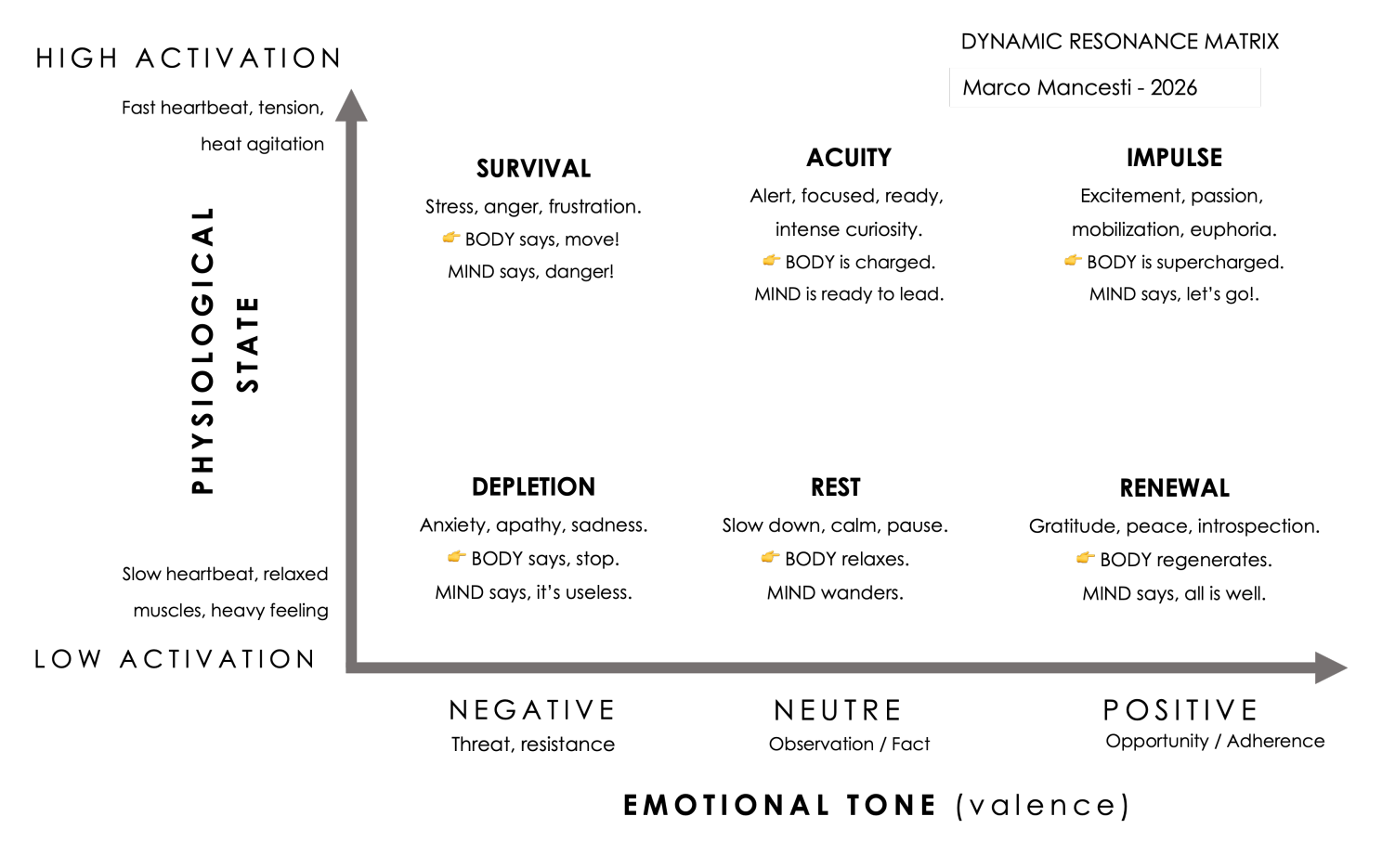
When reading this matrix, it is essential to understand it contextually. The states it describes are not judgemental: there is no right or wrong, and no permanent target state. The dynamic resonance matrix is a navigation instrument, not a performance benchmark. It describes an inner state at a given moment in time. Its value lies in awareness and regulation: Where am I coming from? Where do I need to go given the situation? How much time do I have to move? Depending on context, effectiveness may require activation, recovery, containment, or mobilisation. The objective is not to stay in one zone, but to move deliberately rather than reactively.
2. Curiosity
Cognitive integrity starts with one pre-requisite: curiosity. This eagerness to observe is the fundamental quality required to detect weak signals early, both outside and inside the organisation, to challenge assumptions, to have a "what if I was wrong" mentality in order to constantly learn. Curiosity not only fuels engagement and innovation, it strengthens cognitive plasticity.
3. Critical analysis
Enabled by dynamic resonance mastery, triggered by curiosity, critical analysis is the ability, at all levels in the organisation, to make sense of what is happening in an objective way. It refers to the ability to separate noise from core information, to distinguish a fact from an interpretation and an opinion, to understand if the information that we have is credible, if there are tangible proofs and if the reasoning is solid. It also relates to the awareness of possible biases and conflicts of interests.
4. Informed activation
Sense without movement is inertia. So informed activation is the ability to translate the above insights into concrete action: urgent protective action to gain time, urgent exploration, urgent research, urgent execution or deliberate delay. It is the capacity to distinguish preventive or mitigation actions from core decisions, it is about constantly evaluating priorities, executing them and addressing the next one. Last but not least, it is about being mindful that any activation is only valid as long as it is aligned to the context.
The Distributed Thinking Imperative
Cognitive integrity does not flourish by chance. It is shaped by environment.
Many organisations still believe thinking happens at the top and execution everywhere else. This is a mistake.
Boards and executive committees think, and they execute through influence, stakeholder management, and obstacle removal. Functional leaders execute by showing presence, implication, and sometimes hands-on example.
Frontline teams execute, but they also think: they question instructions that do not make sense, detect emerging risks and weak signals, adapt in real time, and innovate.
Distributed cognitive integrity means something specific: thinking and informed execution happen at every organisational level and across.
This connects directly to what I have explored elsewhere as Shadow Art Leadership, the capacity to lead not through visible force, but through emanating presence that preserves space for others to think, and favours high quality internal dialogue.
Protecting Cognitive Integrity: A Leadership Discipline
The most urgent leadership task today may not be strategy. Nor sustainability. Nor competition. It may be preserving the organisation's cognitive integrity by adopting one simple discipline:
For every capability you delegate to a system, ask:
- Which human capacity will atrophy?
- Will we need that capacity in crisis or novel situations? If yes, do not delegate it yet.
Use AI for scale, speed, and pattern-finding. Use it to augment human judgment, not replace it. But keep independent analysis, contextual reasoning, value integration, and responsibility where they belong: with humans.
In a disruptive environment, cognitive integrity is not a soft asset. It is the most decisive source of difference. This is a call to protect what makes you human: the capacity to think... for when systems will be down...
Originally posted on LinkedIn